Pages

Tuesday, 13 August 2019

Biomass - Science Hurumanu

Hurumanu - From Trash to Gas: Biomass


RENEWABLE ENERGY

Aim: To compare the amount of gas that is produced from different types of biomass.

Material For Bottle 1:
  1.   1cup Horse Manure
  2.   1Bottle
  3.   1Balloon
  4. Gloves 
  5. Water
Material for Bottle 2:
  1.   1cup Horse Manure
  2.   1Bottle
  3.   1Balloon
  4.   1Mashed Banana
  5.   Gloves
  6. Water
Material for Bottle 3:
  1. 1cup Horse Manure
  2. 1Bottle
  3. 1Balloon
  4. 1cup vegetable crops
  5. Gloves
  6. Water
Steps:
  1.  Put on your gloves because you don't wanna touch those disgusting things.
  2.   Get your large plastic bottle and a plastic cup.
  3.  Scoop 1 cup of Horse manure and put it inside the bottle.
  4.  Next, get whatever next ingredients you're doing. Its either, mashed banana and Vegetable crops (optional)
  5. Now get your water and fill the bottle up until it reach this level:
       6.  Now get your balloon and put it at the mouth of the bottle.

The purpose of putting a balloon on top of it is because over time it will fill the balloon with the biomass gas from the inside of the bottle. 


A picture of three bottles with balloons on top, containing cow manure with vegetable peelings or mashed banana.
Energy science project


Investigation.

What is biomass?

What are the 5 types of biomass?

  1.  
  2.  
  3.  
  4.  
  5.  
What are three benefits of biomass?
  1.   
  2.    
  3.    
What are three disadvantages of biomass?
  1.   
  2.   
  3.   

Research the following types of Biomass.
You will need to:
Write a definition of the each fuel.
Answer each question
  • How is it made?
  • What is it used for? 
  • Where is it made? 
  • What is it made with? 
  • What countries use it?   
Place 2 images of the fuel.
What are its uses in the future?

Biomass types.

Name: Agricultural crops.
Definition:

Research:


Uses:
Image:

What are its uses in the future?

Name: Animal waste.
Definition:

Research:

Uses:
Image:

What are its uses in the future?

Name: Bio-gas and Landfill gas
Definition:

Research:


Uses:
Image:

What are its uses in the future?

Name: Solid waste
Definition:

Research:


Uses:
Image:

What are its uses in the future?


Name: Alcohol Fuel
Definition:

Research:


Uses:
Image:

What are its uses in the future?


Tuesday, 6 August 2019

Weather - Science Hurumanu

Weather and Climate Change 

Measuring weather.

Wind

Beaufort
Force
Wind Speed
(KPH)
SpinsIndicatorsTerms Used in NWS Forecasts
00-20Calm; smoke rises vertically.Calm
12-510Shown by direction of wind smoke drift, but not by wind vanes.Light
26-1240Wind felt on face, leaves rustle; ordinary vanes moved by wind.Light
313-2080 Leaves and small twigs in constant motion; wind extends light flag.Gentle
421-29130Raises dust and loose paper; small branches are moved.Moderate
530-39190Small trees in leaf begin to sway; crested wavelets form on inland waters.Fresh
640-50250Large branches in motion; whistling heard in telephone wires; umbrellas used with difficulty.Strong
751-61320Whole trees in motion; inconvenience felt walking against the wind.Strong
862-74390Breaks twigs off trees; generally impedes progress.Gale
975-87470Slight structural damage.Gale
1088-101550Seldom experienced inland; trees uprooted; considerable structural damage occurs.Whole gale
11102-116640Very rarely experienced inland; accompanied by widespread damage.Whole gale
12117 or more730+Very rarely experienced; accompanied by widespread damage.Hurricane

Wind speed - Making an anemometer.

Anemometer

MATERIALS

  1. Straws (4x)
  2.   Cups (4x)
  3.   Pin
  4.   Pencil
  5.   Tape

STEPS

  1. Tape the 2 straws together and also the other 2.
  2.  Make a hole both sides of the cups.
  3.  Put the straws to the holes do the same to the other one.
  4.  Tape them together and make sure the cups are facing the sideways.
  5.  Now get your pin and pin both of the straws over and under one another to the rubber of the pencil. 
Once you have made an anemometer we are going to record the wind speed.

Group size: 5

You will need:

Anemometer (above) 

Roles:


  • Timekeeper
  • Counter
  • Recorder
  • Anemometer Manager
  • Wind generator
  1. Mount the anemometer in a place that has full access to the wind from all directions.
  2. When the timekeeper says "Go", the counter in each group will count how many times the marked cup passes them in one minute and write it down.
  3. If possible, repeat the above step four (4) times and record the average number of spins on the chart.

FINDINGS

  • Record how many times it spins using the table below.
You will need to create the wind yourself by blowing. Get 4 different wind speeds by blowing.

You will need to time them and count the number of spins.

Time IntervalNumber of Spins
1.10 secs1 spin
2.10 secsnone
3.10 secs ?
4.10 secs?
  • Can you make a statement connecting the number of spins of your anemometer and the speed of the wind? 

CONCLUSION:

Our one worked and it can spin. But there's no much wind to spin it around. Also, we didn't have enough time to spin it 4 times. 


Recycling - Science Hurumanu

Aim: To learn practical ways of recycling so that we can make our world a better place.


Video questions:

What has human activity done to our planet?
Create an unnatural greenhouse gasses.

What is Zero Waste?
Definition:
One of the quickest and cheapest ways a community can immediately reduce climate impact.

What stuff has a carbon footprint?
Bags
Chairs
Cellphone
Cars
Toothbrush
Bottle
Boxes

What are 4 easy things to help our planet?
  1.   Reduce
  2.   Repair
  3.   Reuse
  4.   Redesign
What do we need to recycle?

  1. Repairing broken products
  2. Sharing products

What does recycling do to our planet?
Reduce Co2 emissions.

How much of our rubbish is made up of food scraps?
50% of compostable materials.

What does methane gas do to our planet?
It just traps a lot of sunlights 84x.

What does soil do to carbon dioxide in the atmosphere?
Pulls carbon dioxide down from the atmosphere.

What do using zero waste practices do to our planet?
Reduce and compost rubbish.

    What is a carbon footprint?


    What is your Carbon Footprint?


    You are now going to look at your own carbon footprint by taking a questionirre. Remember to 'Add details to improve accurcay'.

    Based on the questionaire what is your:

    1. Ecological Footprint
    2. Carbon Footprint

    How many planets did you have?
    3 and a half


    What is your personal Earth overshoot day?

    ENERGY SAVING TIPS FILM


    Name 4 of the tips.

    1.   
    2.   
    3.   

    MY INVESTIGATION.


    Image result for rates of decomposition


    • Choose 6 items from the list.
    • Investigate them using Google.
    • Answer the 4 questions below.


    Name: 
    1. How long does this resource take to decompose?
    2. What resource / fossil fuel are they made from?
    3. How does making this object contribute to climate change?
    4. How is this resource recycled?


    Aim: To learn practical ways of recycling so that we can make our world a better place.


    Video questions:

    What has human activity doen to our planet?


    What is Zero Waste?
    Definition:

    What stuff has a carbon footprint?

    What are 4 easy things to help our planet?
    1.   
    2.   
    3.  
    4.  
    What do we need to recycle?


    What does recycling do to our planet?


    How much of our rubbish is made up of food scraps?


    What does methane gas do to our planet?


    What does soil do to carbon dioxide in the atmosphere?


    What do using zero waste practices do to our planet?


      What is a carbon footprint?


      What is your Carbon Footprint?


      You are now going to look at your own carbon footprint by taking a questionirre. Remember to 'Add details to improve accurcay'.

      Based on the questionaire what is your:

      1. Ecological Footprint
      2. Carbon Footprint

      How many planets did you have?

      3 and a half


      What is your personal Earth overshoot day?

      ENERGY SAVING TIPS FILM


      Name 4 of the tips.

      1.   
      2.   
      3.   

      MY INVESTIGATION.


      Image result for rates of decomposition


      • Choose 6 items from the list.
      • Investigate them using Google.
      • Answer the 4 questions below.


      Name: 
      1. How long does this resource take to decompose?
      2. What resource / fossil fuel are they made from?
      3. How does making this object contribute to climate change?
      4. How is this resource recycled?


      Science Hurumanu - The Water Cycle

      Hurumanu: The Water Cycle


      AIM: TO LOOK AT THE WATER CYCLE AND HOW CLIMATE CHANGE IS AFFECTING IT.

      Definition:


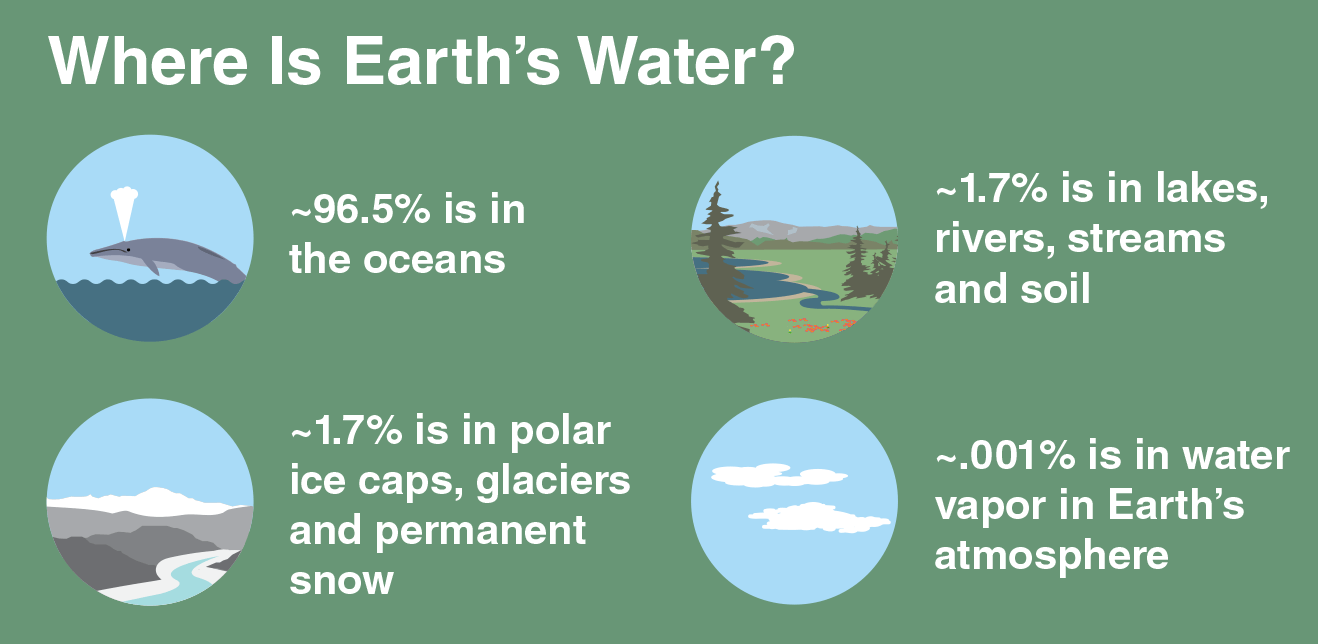
      A green box with icons and white text. Text reads: Where is Earth's Water? 96.5 percent is in the oceans; 1.7 percent is in lakes, rivers, streams, and soil; 1.7 percent is in polar ice caps, glaciers, and permanent snow; 0.001 percent is in water vapor in Earth's atmosphere

      Scientific words:


      • Evaporation. When water is heated by radiant energy it turns into water vapour.
      • Transpiration. Evaporation from plants.
      • Condensation. When water vapour cools, molecules join together and form clouds.
      • Precipitation. When clouds get heavy the waters falls as rain, sleet, hail, or snow.
      • Acidification: the action or process of making or becoming acidic.

      We will be conducting an experiment that looks at the different ways that climate change is affecting the water cycle.
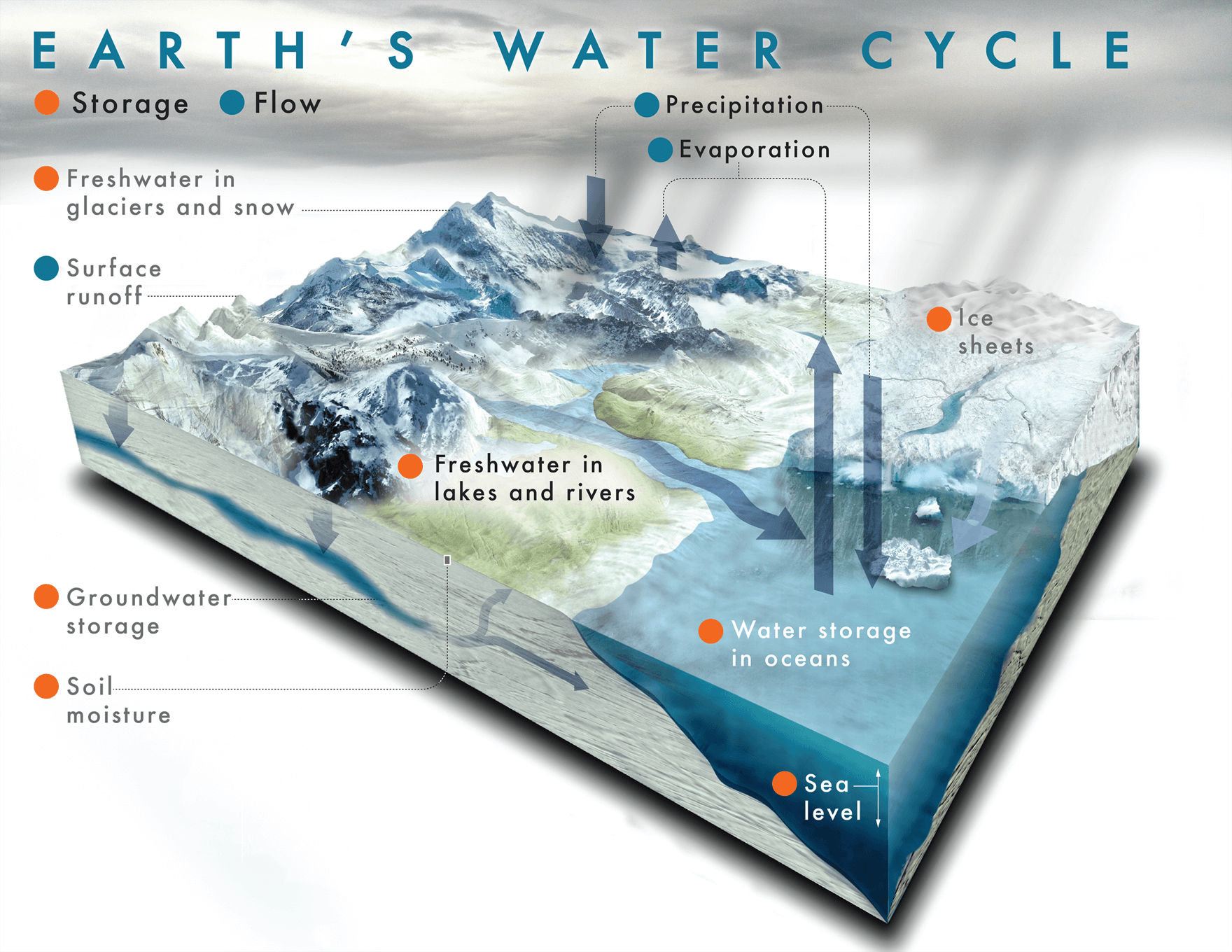
      An illustration of the water cycle showing how water travels from rivers and streams to clouds to snow and back again

      THE WATER CYCLE EXPERIMENT

      Bag 1: Normal Water cycle
      Bag 2: Water cycle with CO2 added: like Oceans in climate change
      Bag 3: Water cycle with ice added: like Antarctica in climate change

      Material:

      1. 1x cup Water / Soda Water
      2.  3x Bag
      3.  1x Blue Food Colouring
      4.  1x A piece of Litmus Paper
      5.  1x Permanent Marker
      6.  Sand 

      Steps:

      1.  Get a piece of a large bag and a permanent marker from a teacher.
      2.  Draw the water cycle on the bag and labelled it (optional)
      3.  Pour a 1 cup of Water or Soda water into the Bag.
      4.  2 drops of blue food colouring into the bag.
      5. Hang the bag in the window.
      6. In Bag 2 I added a piece of Litmus paper hanging at the top. Make SURE it doesn't touch the water.

      Two Images:


      Findings:


      The Water Cycle: Bag 1
      CO2 Water Cycle: Bag 2
      Acid
      Desert Water Cycle
      Bag 3
      Does it cycle?
      YesYesYes
      Amount of Water
      222
      Acidity
      131

      Key: Water and acidity amount: 1 = none 
      2 = small 
      3 = large 

      Other comments:


      1. Bag 1 cycled water.
      2. Bag 1 had a small amount of water.
      3. Bag 1 had none of the Acidity.
      4. Bag 2 cycled water.
      5. Bag 2 had a small amount of water.
      6. Bag 2 had a large amount of acidity.
      7. Bag 3 cycled water.
      8. Bag 3 had a small amount of water.
      9. Bag 3 had none of the amounts of acidity.


      Conclusion:

      Bag 1 had cycled water, it has a small amount of water and it has none of the acidity.
      Bag 2 had cycled water, it has a small amount of water and it has a large amount of acidity.
      Bag 3 had cycled water, it has a small amount of water and it has none amount of acidity just like Bag 1 it is almost the same.


      Draw a labelled diagram of the Water Cycle

      Water cycle words:
      1. Precipitation
      2. Hurricanes
      3. Acid rain
      4. Evaporation
      5. Carbon Dioxide
      6. Water
      7. Defirestation
      8. Water vapour
      9. Transpiration
      10. Flooding


      TODAY YOU WILL BE INVESTIGATING THE EFFECTS THAT CLIMATE CHANGE HAS ON THE WATER CYCLE.

      1. Using your SOLO hexagons poster write a paragraph about the different aspects of climate change.
      2. Write about the following Climate Change concepts:
      You can do these by powerpoint, embedding a movie , on your blog, on a doc or any other form of presentation. It is up to you.

      ACIDIFICATION: HOW DOES CLIMATE CHANGE CONTRIBUTE TO THE ACIDIFICATION OF OUR OCEANS?


      Picture:


      Diagram of how it affects the water cycle.


      DEFORESTATION: HOW DOES DEFORESTATION AFFECT CLIMATE CHANGE?


      Picture:


      Diagram of how it affects the water cycle.


      ICE CAP MELT: HOW DOES ICE CAP MELT AFFECT CLIMATE CHANGE?


      Picture:


      Diagram of how it affects the water cycle.


      WATER VAPOUR: HOW DOES CLIMATE CHANGE CONTRIBUTE TO WATER VAPOUR AND EVAPORATION?


      Picture:


      Diagram of how it affects the water cycle.


      Monday, 5 August 2019

      "Doughnut" - Stopmotion Art Hurumanu Finished!

      Kamusta! This week in Art Hurumanu, we've finally finished the Stopmotion project we're doing. It's called "Doughnut" for some reason because It's held in Dunkin' doughnut shop. Before I show you guys the finished product, I'm going to tell you the things that we've done to produce a completed, amazing, cringy stop-motion. 

      Firstly, we were randomly grouped with a mix of people between the two classes which is Bh and Tz.
      My groupmates were Rarotonga and Charlie. Then, we have to choose our main topic in Manaakitanga and we chose Kindness. We were actually inspired by the short film called "Kindness Ripple" where a man helped a poor family to buy something in the grocery store and years later the kindness that he did return to him. 

      Anyways, after choosing a topic Whaea Rowena taught us the types of angles you could do in stop motion. We also did research about the successful people that do illustrate like Quentin Blake. Quentin Blake is one of the examples of people who draw fast and quick but you could see the details. We take him as an example for our next task to do which is StoryBoard. A storyboard is a piece of big paper where there's a lot of small boxes where you can draw each scene is happening on your stop motion.

      Short story, me and my group decided to do a stop motion about Doughnut and kindness. The purpose of our storyboard is that so we can remember what is next in our Stopmotion. My group and I only completed 1 storyboard sheet but that's enough to see what's going on in our story. 

      Next, we need to do writing about our stop-motion. Miss Birtch taught us how to write a Narrative with good quality. She also taught us to use interesting words instead of boring words. 

      Lastly, We did our characters. The characters are Liam, Shine, Sandy - the cashier and Mina. We started making our characters if your doing clays and also the backgrounds and bit and pieces.

      After that, we did the script and finally, we film the stop-motion with our Chromebooks. But we need to finish the filming the stop-motion then do a voice-over of it.

      Finally, All you've been waiting to.
      Here's our Cringey Stop-motion:


      Thanks for reading this LONG post!
      Please comment on what you think, thank you.
      Bye have a great day!